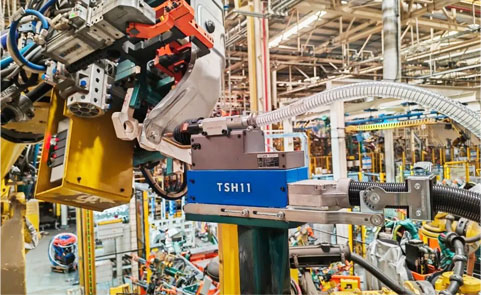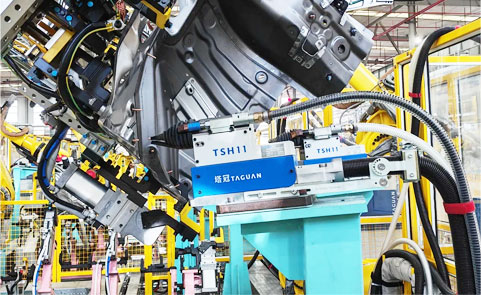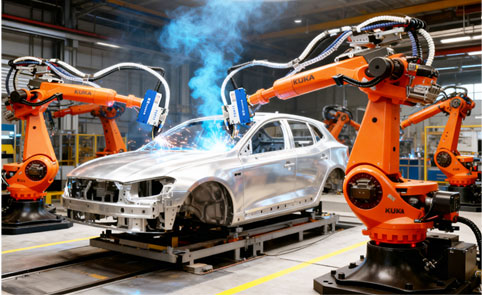









To achieve lightweight design for new energy vehicles, automakers widely adopt aluminum alloy for vehicle bodies, which correspondingly requires aluminum studs for welding. Due to the material characteristics of aluminum — easily forming a high-melting-point oxide film on the surface and featuring high thermal conductivity — welding aluminum studs has long been a major process challenge.
Leveraging phased precise regulation + full-process shielding, Taguan AC stud welding technology breaks the entire welding procedure down into six core steps. It fundamentally resolves the inherent difficulties of aluminum welding while ensuring high efficiency and stable quality. Below is a complete presentation of the full AC aluminum stud welding process with detailed process parameters and technical highlights.
01 Pre-Welding Preparation: Welding Gun Posture & Shielding Gas Ready
The first step of AC aluminum stud welding is to standardize equipment posture and shielding gas coverage area, which is the prerequisite to avoid subsequent welding defects.
Part 1 Welding Gun Positioning: Posture Matched by Stud Specification
· For T5, T6 or M6 aluminum studs: The welding gun is allowed to tilt within the ±90° permissible blue zone, adapting to non-planar welding scenarios such as automotive body curved surfaces and brackets.

· For M8 grounding studs and M8 large-flange studs: The gun must be kept vertically downward within ±15°, ensuring uniform stress on large-size studs and avoiding fusion offset.
The white shielding gas hood and blue sealing hood at the gun head shall be selected to match stud dimensions in advance. They replace traditional support rods to prevent sheet metal displacement and avoid scratches caused by direct contact between the clamping head and workpiece surface.

Part 2 Shielding Gas Purging to Isolate Oxidation Risks
The melting point of the natural oxide film on aluminum surfaces reaches up to 2054°C, far higher than aluminum’s own melting point of 660°C. Without air evacuation before welding, the oxide film will severely impair fusion quality.
The welding gun activates the pre-flow shielding gas program, continuously delivering 99.99% pure argon through the gas hood to displace oxygen in the welding zone. Even on curved panels, the blue shielding gas sealing hood forms a tight seal between the gun head and workpiece, preventing argon leakage and maintaining shielding gas concentration above 99.5% in the working area.
02 Four-Step Precise Temperature Control for Uniform Fusion of Aluminum Studs
The core advantages of AC welding lie in adjustable current output and arc stability. Taguan adopts a four-phase process: arc ignition & cleaning → arc stretching & melting → plunging & fusion → solidification & gun retraction, solving the problems of aluminum’s high thermal conductivity and rapid molten pool cooling.
Part 3 Arc Ignition & Cleaning: Break Oxide Film to Remove Fusion Barriers
After welding starts, the machine first outputs dedicated cleaning ignition current customized for aluminum oxide removal:
· By regulating current intensity, the high-frequency AC arc slightly melts the tip of the aluminum stud and the panel surface, breaking through the oxide film while preventing carbonization of the aluminum surface from overheating.
· Meanwhile, the AC automatic polarity switching function is activated. Periodic alternating current polarity ensures even heating at the contact interface between stud and aluminum panel, preliminarily removing surface oil stains and impurities to clear the way for subsequent fusion.
Part 4 Arc Stretching & Melting: Precise Penetration Control to Avoid Excessive Aluminum Burn-Off
Upon completion of cleaning, the machine switches to main welding current and enters the core melting stage:
· Built on Taguan’s dual inverter power supply architecture, the main current is output in the form of high-frequency AC pulses. Each welding pulse is independently programmable to control molten pool depth — guaranteeing fusion strength without panel burn-through.
· Core technical support: The welding arc cycles through combustion, extinction and re-ignition during AC welding. Taguan’s arc maintenance technology establishes a dynamic physical model to precisely inject electric field intensity before arc extinction, preventing arc breakage and discontinuity and maintaining stable continuous heating of the molten pool.
Part 5 Plunging & Fusion: Precise Motor Pressure Control for Tight Welding Joints
When the molten pool reaches the preset depth, the process enters the plunging and fusion phase. The key here is to avoid deformation of the aluminum molten pool from impact force:
· Taguan’s linear motor drives the aluminum stud to descend at a constant speed, eliminating molten pool overflow caused by the rapid pressing action of traditional welding equipment.
· Continuous AC polarity switching ensures uniform melting at the contact surface between stud and aluminum panel.
Part 6 Solidification & Gun Retraction: Post-Flow Shielding Gas Prevents Cooling Oxidation
After the stud is pressed into the molten pool and held at preset pressure for initial solidification, the post-flow shielding gas program is triggered:
· Pure argon is discharged for 0.5 seconds to isolate ambient air and prevent re-oxidation of the welded joint during cooling.
· Once the molten pool is fully solidified, the welding gun retracts smoothly. The single-point welding time varies by stud model, fully meeting the takt time requirements of industrial production lines.
Essentially, Taguan’s AC aluminum stud welding process is a full-process solution tailored to aluminum material properties: from pre-flow shielding gas for oxidation isolation, arc ignition cleaning for barrier removal, to precise temperature control during arc stretching and plunging. Every step is designed around oxidation prevention and uniform fusion.
Retaining the inherent strengths of stud welding — fast speed, high reliability and non-drilled connection — this process perfectly solves the unique challenges of aluminum welding. It has been widely applied by multiple new energy vehicle manufacturers in battery pack brackets, automotive aluminum body structures and industrial aluminum frames, serving as an efficient and reliable aluminum connection solution.